Synonym(s):
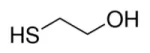
β-Mercaptoethanol, 2-Hydroxyethylmercaptan, BME, Thioethylene glycol
CAT Number: 3148
CAS Number: 60-24-2
Linear Formula:
HSCH2CH2OH
Molecular Weight:
78.13
 EC Number:
200-464-6
MDL number:
MFCD00004890
PubChem Substance ID:
57654402

PROPERTIES

vapor density                    2.69 (vs air)

Quality Level               200

vapor pressure                 1 mmHg ( 20 °C)

assay                                     ≥99.0%

form                                         liquid

expl. lim.                                 18 %

concentration                     14.3 M (pure liquid)

refractive index                n20/D 1.500 (lit.)

pH                                         4.5-6 (20 °C, 500 g/L)

bp                                             157 °C (lit.)

density                                 1.114 g/mL at 25 °C (lit.)

storage temp.                   2-8°C

SMILES string                  OCCS

InChI                                  1S/C2H6OS/c3-1-2-4/h3-4H,1-2H2

InChI key                          DGVVWUTYPXICAM-UHFFFAOYSA-N

Description


General description

2-mercaptoethanol is a thiol compound, commonly used as a reducing agent in organic reactions.

Packaging

10, 100, 250, 500 mL in glass bottle
1, 2.5 L in glass bottle

Application

2-mercaptoethanol is widely used for retarding oxidation of biological compounds in solution.
BME is suitable for reducing protein disulfide bonds prior to polyacrylamide gel electrophoresis and is usually included in a sample buffer for SDS-PAGE at a concentration of 5%. Cleaving intermolecular (between subunits) disulfide bonds allows the subunits of a protein to separate independently on SDS-PAGE. Cleaving intramolecular (within subunit) disulfide bonds allows the subunits to become completely denatured so that each peptide migrates according to its chain length with no influence due to secondary structure.

RELATED PRODUCTS

SAFETY INFORMATION

Pictograms

CorrosionSkull and crossbonesHealth hazardEnvironment
GHS05,GHS06,GHS08,GHS09

Signal Word

Danger

Hazard Statements

H301 + H331 – H310 – H315 – H317 – H318 – H361d – H373 – H410

Precautionary Statements

P273 – P280 – P301 + P310 – P302 + P352 + P310 – P304 + P340 + P311 – P305 + P351 + P338

Hazard Classifications

Acute Tox. 2 Dermal – Acute Tox. 3 Inhalation – Acute Tox. 3 Oral – Aquatic Acute 1 – Aquatic Chronic 2 – Eye Dam. 1 – Repr. 2 – Skin Irrit. 2 – Skin Sens. 1A – STOT RE 2 Oral

Storage Class Code

6.1A – Combustible, acute toxic Cat. 1 and 2 / very toxic hazardous materials

WGK

WGK 3

Flash Point(F)

165.2 °F – closed cup

Flash Point(C)

74 °C – closed cup

Personal Protective Equipment

dust mask type N95 (US), Eyeshields, Gloves

PROTOCOLS AND ARTICLES

Protocols

Protocols for the Fmoc SPPS of Cysteine-containing Peptides

Overcome challenges in synthesis and disulfide bond formation with protocols for Fmoc solid-phase peptide synthesis of peptides with cysteine and methionine.

Protocols for the Fmoc SPPS of Cysteine-containing Peptides

Overcome challenges in synthesis and disulfide bond formation with protocols for Fmoc solid-phase peptide synthesis of peptides with cysteine and methionine.

Protocols for the Fmoc SPPS of Cysteine-containing Peptides

Overcome challenges in synthesis and disulfide bond formation with protocols for Fmoc solid-phase peptide synthesis of peptides with cysteine and methionine.

Protocols for the Fmoc SPPS of Cysteine-containing Peptides

Overcome challenges in synthesis and disulfide bond formation with protocols for Fmoc solid-phase peptide synthesis of peptides with cysteine and methionine.

Reviews

There are no reviews yet.

Be the first to review “2-Mercaptoethanol ≥99.0%”

Your email address will not be published. Required fields are marked *